Research · UNIOESTE
UNIMET
I developed UNIMET through undergraduate research at UNIOESTE, supervised by professor Adriana Postal. The project automates access to INMET weather data and lets users customize data frequency for research and public use.
- Context
- Research · UNIOESTE
- My role
- Fullstack developer · undergraduate research
- My contribution
- Node.js/Express API and React/TypeScript interface to automate historical queries and aggregate data at hourly, daily, weekly and monthly frequencies.
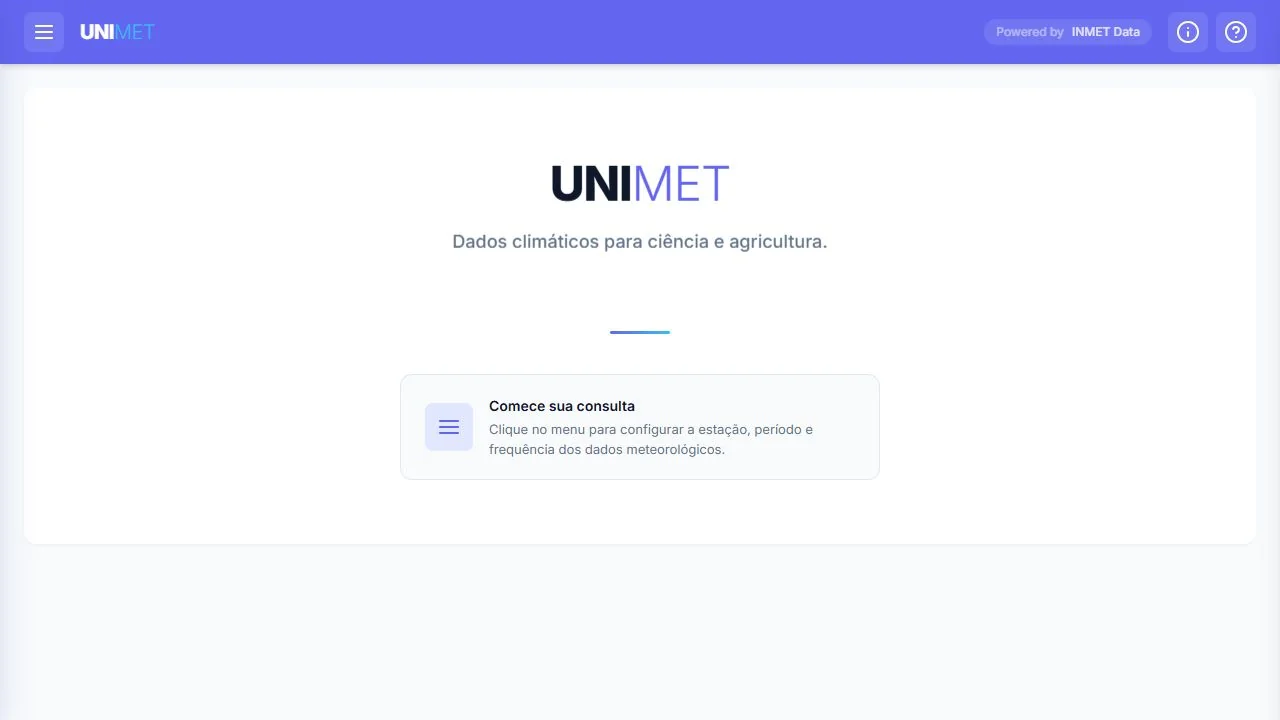
Problem: fragmented historical queries
The research started from a limitation encountered in INMET data access: queries of up to six months. Longer studies required multiple requests and manual concatenation of results.
UNIMET organizes station, date range and frequency selection in an interface familiar to existing INMET users, connecting data collection to analysis in science and agriculture.
Role and fullstack contribution
I worked on the Node.js, TypeScript and Express REST API to connect to the source and process data, and on the React/TypeScript interface with Material UI to configure and present queries.
Separating frontend and API helped organize responsibilities and reuse components. The work was developed in a data analysis, processing and visualization research context, with academic supervision.
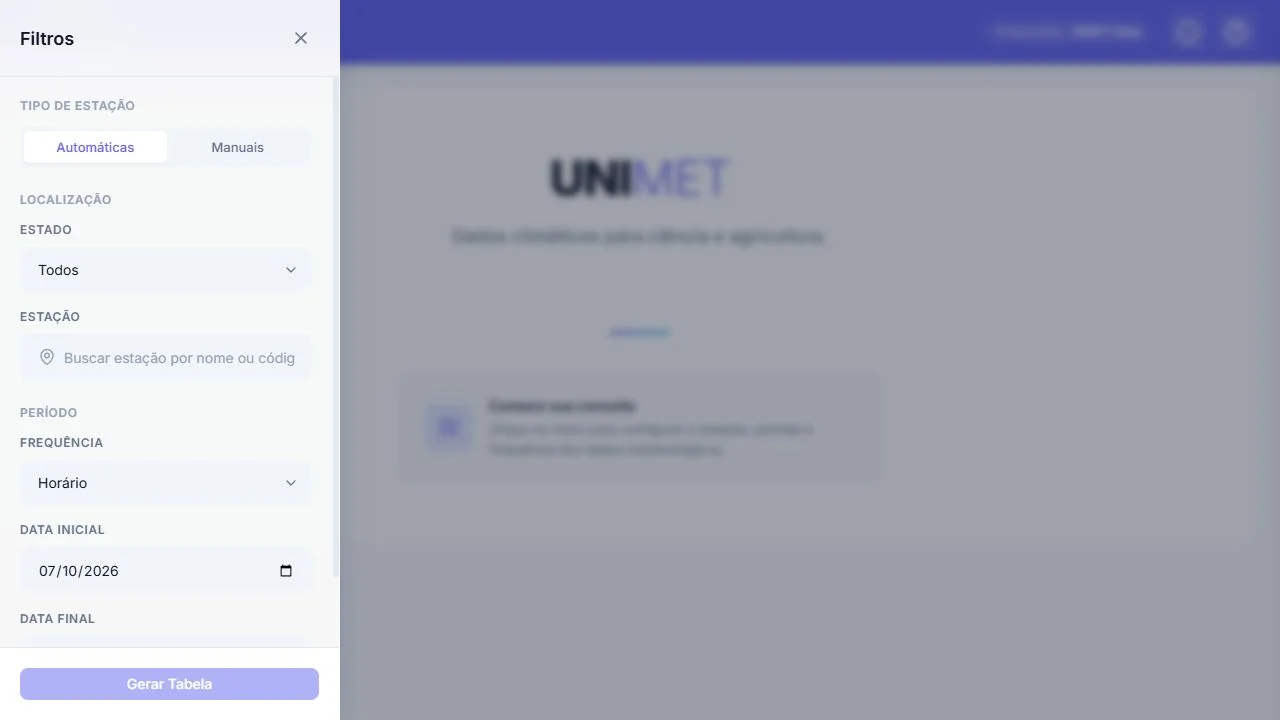
Decision: access the source without local persistence
The API queries INMET's service and processes the data needed by the interface. The implementation described in the paper uses a simplified MVC adaptation, with controllers for routes and processing and supporting entities.
The workflow operates without its own database. Modular organization keeps the interface separate from integration and processing rules, making each part easier to maintain.
Decision: aggregate according to each variable's meaning
Queries support hourly, daily, weekly and monthly frequencies. Hourly data follows the source response; other frequencies apply processing according to each field's meaning.
Rainfall is summed over the period; solar radiation uses the sum of positive values; extremes use maxima and minima. Fields such as pressure, wind speed and humidity use averages. In the described method, mean temperature is calculated as (Tmax + Tmin) / 2.
Evidence and results
The undergraduate research paper records the implementation of frequency customization and a modular interface. The public application and backend repository provide evidence of the query workflow and its technical organization.
The deliverable combines collection, temporal processing and CSV/XLSX export in a dedicated interface, allowing data to move into spreadsheets and other analysis tools.
Limitations and scientific context
The project depends on access to and documentation of INMET's API, as well as measurement availability by station and period. The research recorded challenges in integrating with this external source.
The aggregation rules described are implementation choices. Scientific use requires checking data quality and whether the method suits the intended analysis, retaining attribution to INMET.