Institutional project · UNIOESTE
SAD-UEPR
SAD-UEPR began as my undergraduate thesis and became an official UNIOESTE project. I now serve as its technical lead through a research scholarship, guiding the team's work from financial queries towards a platform that also handles Higher Education Census microdata.
- Context
- Institutional project · UNIOESTE
- My role
- Thesis author and technical lead of the institutional project
- My contribution
- Original thesis implementation and team leadership in its fullstack evolution, using FastAPI, React, SQLite persistence and INEP Census ETL.
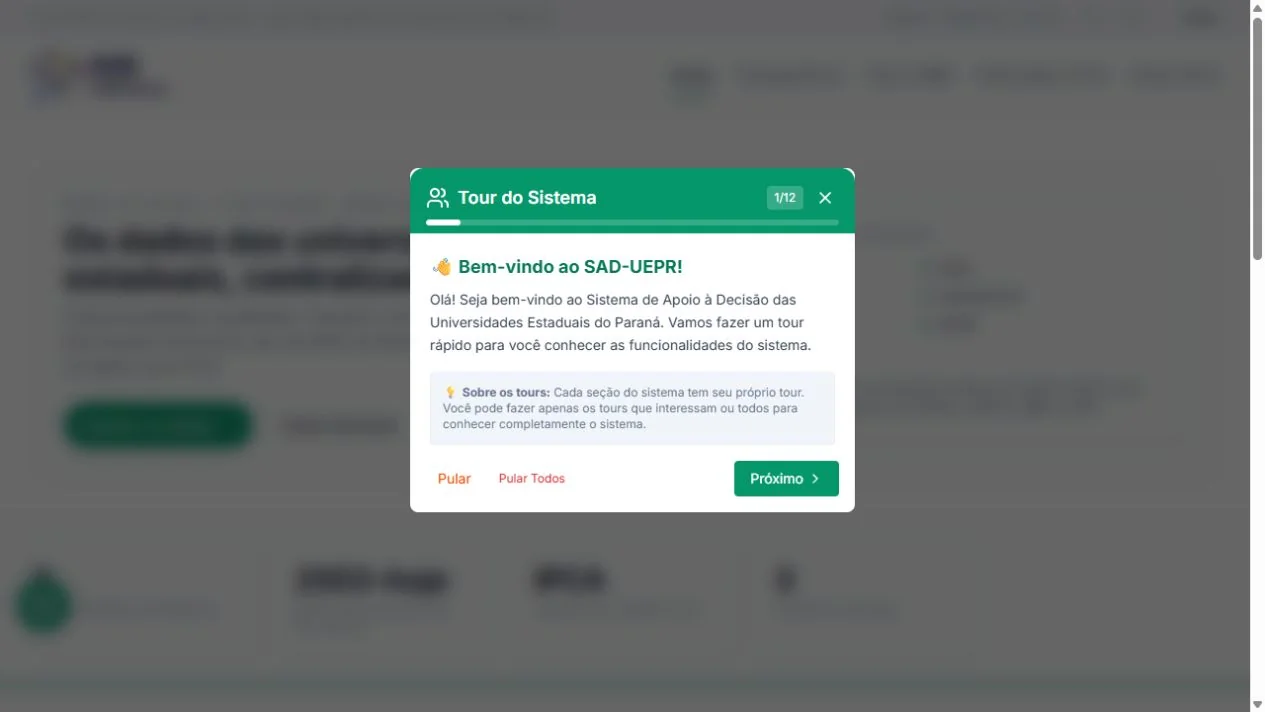
From thesis to institutional project
The starting point was to bring together Paraná state university financial data from the Transparency Portal, supporting queries, comparisons and IPCA inflation adjustment.
For my thesis, I developed Python collection and processing, multithreading and the React/Vite interface, using SSE to track processing. This original implementation became the basis for the institutional project.
My role in the team's evolution
Since May 2026, I have provided technical leadership for the scholarship team through code review, mentoring, development standards, sprint planning and delivery organization.
I guide fullstack development and integration between data, API and interface. The new capabilities are team deliverables, supported by technical guidance and documentation of decisions, reviews and limitations.
Decision: modular monolith and analytical persistence
The original separate services were consolidated into a modular FastAPI monolith in a monorepo. The frontend uses React, TypeScript and TanStack Query; Docker and GitHub Actions support delivery in the institutional environment.
The Census module introduced SQLite persistence with SQLAlchemy. Its ETL uses Polars for reading and processing, Parquet checkpoints and transactional loading. Chunked processing reduces the need to materialize an entire year in memory.
INEP Census: expanding the scope with context
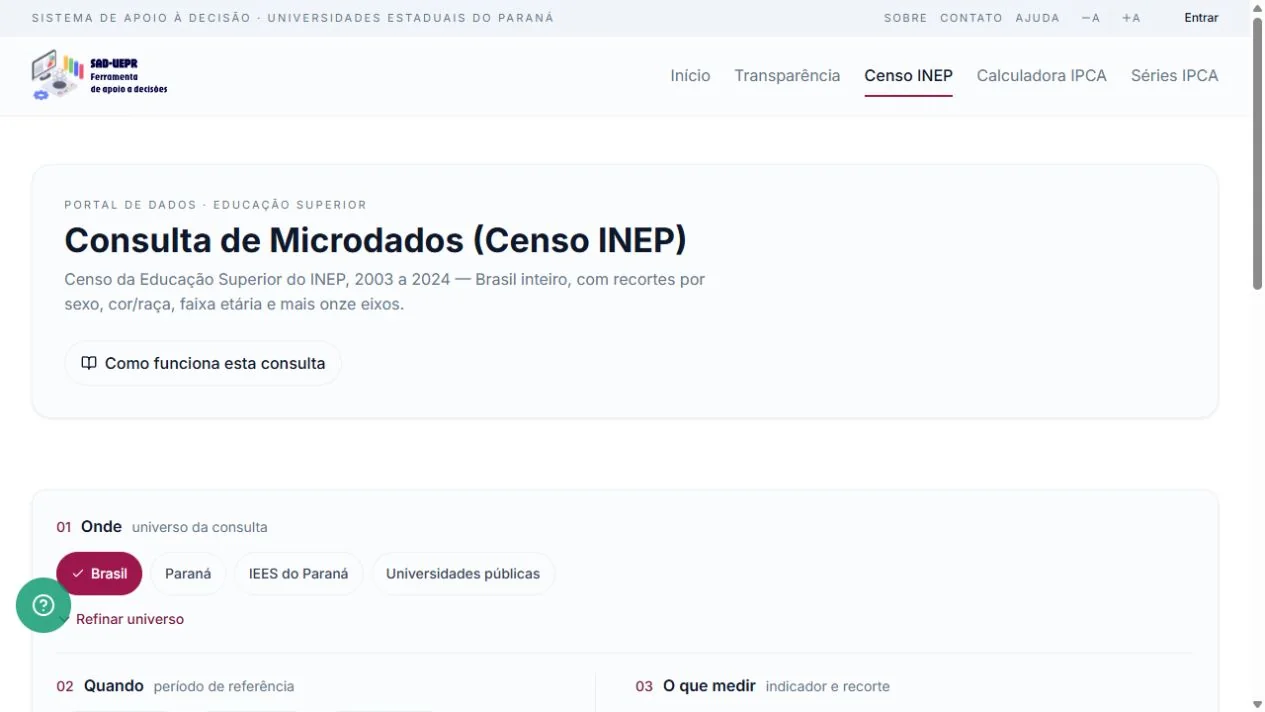
The educational domain handles INEP Higher Education Census data, with historical layouts from 2003 to 2024 and expansion from Paraná state universities to institutions across Brazil.
Indicators such as enrollments, entrants and graduates can be queried by period, institution and other dimensions. The catalog records availability by year and distinguishes uncollected data from a real zero, preserving the context of changes in files and categories.
Guided ingestion and asynchronous processing
The authenticated workflow supports uploading INEP files, inspecting a preview, mapping columns and tracking ingestion. The loading scope is explicit; the system classifies course files and institution registries and communicates partial loads.
SQLite allows one writer at a time. To avoid competing with the long-running ETL transaction, live loading progress stays in memory and is polled by the interface; persisted state records stages. This decision accounts for the API's current single-process deployment.
Interface, validation and delivery
The interface combines expenditure and revenue queries, IPCA tools and Census analysis with tables, charts and export. Census queries persisted in the URL allow users to restore context and share the question; pagination and sorting run on the server.
The project uses Pytest, Vitest and Playwright, including SQLite integration tests and browser workflows. Data validation considers independent references such as INEP's Statistical Synopsis and consistency between aggregations. Continuous delivery uses containers and automation on UNIOESTE infrastructure.
Results and limitations
The result is an institutional platform connecting financial and educational data through querying and preparation workflows. My involvement combines thesis authorship, architecture evolution and leadership of a development team.
The documented Census coverage ends in 2024. Availability and comparability depend on sources, layouts and historical category changes; gaps need to be shown in the analysis. New interface studies describe proposed improvements. The public source links on this page refer to the original thesis components.